Pro-Files in Jazz Guitar
by Eric Elias
Pro-Files in Jazz Guitar is designed
to introduce you to some of the great jazz guitarists
that might not be as visible as our favorite players.
These guitarists might be in less visible roles
such as studio players or school instructors. Pro-Files
will include everything from e-mail conversations,
CD and concert information, interviews and master
class excerpts to introduce you to some fantastic
players. You never know, some of them might be playing
right in your local area. This issue will feature
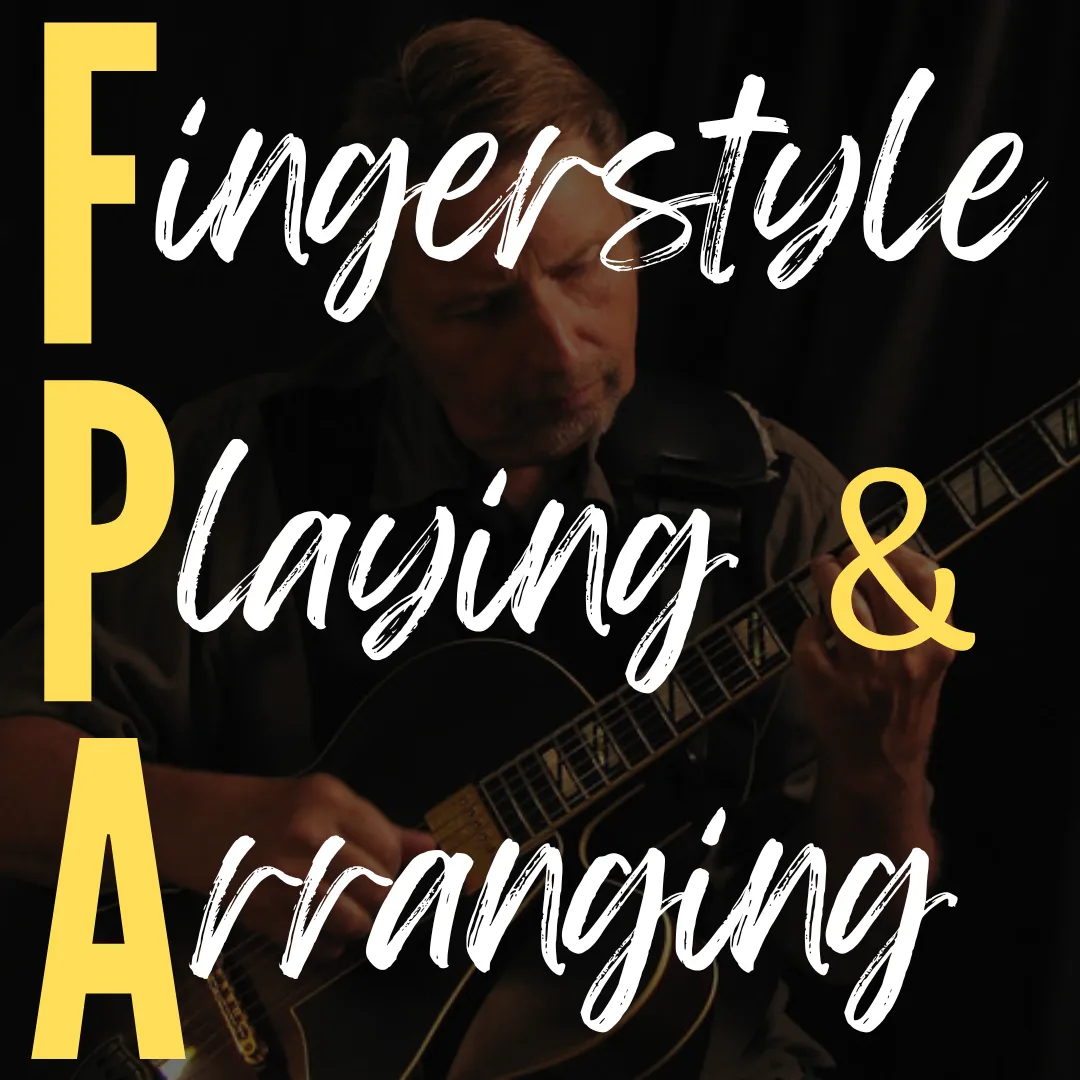
jazz and fingerstyle guitarist Rich Severson who
hails from Coarsegold, CA.
Rich Severson is the founder and
director of Guitar College, a home study guitar
curriculum that provides coursework in theory and
technique, jazz, blues, fingerstyle and country
playing. Rich is a former Musician’s Institute of
Technology (M. I.T.) instructor and has several
instruction books published by Dale Zdenek. He is
a California certified teacher and has performed
with players such as Chuck Berry and Bo Diddley.
Rich currently has a number of CDs available featuring
jazz, gospel and Christmas music in both solo fingerstyle
and combo settings. At age 51 he is as busy as ever,
doing clinics and workshops for Guitar College,
Hofner Guitars and Christian music seminars. Rich
endorses Hofner guitars, Boomerang Phrase Samplers
and Sibelius Software. He is also a dealer for these
products.
EE: Who were your earliest musical
influences?
RS: Brahms and Bach; I took piano lesson at age
five through ten. I guess I was pretty good because
I did win a couple of trophies. My mother played
piano and my father loved big band music and was
always playing records.
EE: Who were your earliest guitar
influences?
RS: Gene Autry was probably my very first influence
on guitar. I remember him playing guitar, shooting
a gun while riding a horse and always got the girl,
who wouldn’t want that? Later it was the Beach Boys,
Dick Dale, The Ventures, Ricky Nelson, The Beatles
and The Yardbirds,
EE: Sounds like the normal guitar
interests for a kid growing up in the 50’s and 60’s.
So, how old were you when you started playing guitar
and what circumstances led you to be interested
in jazz?
RS: I’ve always had a guitar since I was three (a
Mickey Mouse with the crank). When I was about six
my Mom and Dad took me down to a pawnshop and I
got a Stella. My mother could play a few chords
and knew how to tune it. When I was thirteen I asked
my mother for guitar lessons for my birthday and
that Christmas she bought me a Telecaster and a
Vibroverb amp, boy that was an exciting day. Sure
wish I still had them. I always had real good teachers;
Bill Eucker was my first, what a player. I would
like to know what happened to him. Another teacher
Bob Door was a big influence he started me on chord
melodies. I could already read music from playing
piano so I did have an advantage. I met this older
guy, Ed Mendel, who turned me on to jazz guitar.
He played me a Tal Farlow record; I had never heard
anything like that. He always wanted me to show
him rock licks and then he’d show me a jazz lick.
Then a friend gave me Wes’ “Bumpin” album which
had the tune “Tear it Down.” I found the transcription
in Downbeat, learned it and I was hooked on jazz
from then on. I played in bands all through high
school. One of my high school bands was with Pat
Flynn, a Nashville studio player. All four of us
in that band are still playing and have groups.
We had a recording contract and also started doing
some studio work while still in high school. When
I started college I really got into jazz. I played
in the big band and made the trek into LA to study
with Mitch Holder, what a great influence; Mitch
had studied with Howard Roberts. I started teaching
at Ernie Ball guitars in Tarzana with Ted Greene.
We would play together when we had a break together,
what a treat, Ted could show you something in 5
minutes and I could expand on it for a month!
Around that time I took a couple of lessons from
Joe Pass. Then I heard about a jazz teacher named
Charlie Shoemate. Charlie is a great vibes player
and played with George Shearing when Joe Pass was
with him. Charlie’s method was simple, “Here’s a
transcribed jazz solo and the recording, go home
and learn it, memorize it and be able to play it
in 3 keys.” I made the most growth in my playing
with that simple method and I’ve applied that to
my own teaching. If a student has the written music
with a recording and can understand the theory and
harmony of the piece and has woodshed his technique
and chord inversions he has the tools to become
an accomplished player.
EE: I agree. It sounds like you
have a lot of influences. How would you describe
your musical style today?
RS: Mainly bebop/blues. I like and appreciate all
the styles and have explored many of them but always
came back to jazz. I’ve always thought I should
focus on just one, but never could.
EE: I definitely know that feeling.
What context are you currently showcasing your music
in?
RS: I play in a number of settings; as a solo guitarist
usually on nylon string, in a jazz trio with guitar,
bass and drums (sometimes adding a singer, sax or
piano) and with a smooth jazz quintet, guitar, bass,
drums, piano and sax. I also play with an 11-piece
group: 4 horns, 4 rhythm 3 singers. In addition
to all that I’m currently the musical director at
a large church in Fresno and play in several other
situations including orchestras and big bands. Fresno
has a lot of great musicians and there are plenty
of opportunities to play. I also play at guitar
shows around the country in the Guitar College and
Hofner booths and do workshops. I do all the California
shows and also did the Arlington, Dallas, Detroit,
New Jersey, Las Vegas, and Charlotte shows last
year. Our kids are all grown up now so you never
know where I’ll turn up next.
EE: Hopefully you’ll make it out
to the east coast some time soon. Tell me about
your current equipment. What guitars are you using
now?
RS: I have a house full various guitars and amps
but my favorite guitars are the Hofner Jazzica,
Verithin and Vice president, G&L ASAT Classic,
’66 Howard Roberts Epiphone, and Gibson Chet Atkins
nylon for solo gigs. The amps that I use regularly
are Traynor Valve 40, Fender Twin and Vibrolux.
I don’t leave home without the Boss ME30 effects
processor. One of the most useful fun tools I have
for practicing is the Boomerang Phrase Sampler.
It’s also great for gigs and composing. I have struggled
for years to get my music software to do what it
says it will do and finally found Sibelius by far
to be the most user friendly program I have ever
worked with. I use it almost daily for writing lead
sheets and arrangements. The new G7 is even easier
and just for guitar players.
EE: What is your favorite context
to play in?
RS: Just a guitar, bass, and drums trio is the most
demanding and fun for me. You may not hear many
guitar players say this but I also like the big
band and orchestra gigs where I just show up and
read the charts. I guess I like it all, with a big
variety nothing gets boring. I like teaching gigs
too. I started teaching privately at 14 and have
taught ever since. When I got my drivers license
I immediately got a job teaching at the local music
store. They say if you really want to learn something,
teach it and that’s true. I encourage all of my
students to do a little teaching. I wrote three
books for Dale Zdenek Publications in the early
80s, (publisher of the famous “Chord Chemistry”
book); “Blues and Rock Solos,” “Country and Rock
Solos,” and “Guitar Technique”. That company was
last owned by Warner Bros. and my books are currently
out of print. From ’88-’91 I was a GIT Instructor.
I started Guitar Correspondence in ‘89 which evolved
into Guitar College in ‘93 and have been doing that
ever since. Mostly I stayed close to home with my
wife and four children. I did many demo sessions,
and “B” movie soundtracks, including producing demos
and jingles in my own studio.
EE: Who are some of your favorite
people to play with?
RS: Gary Newmark, drums, Roy Carlson, bass and Darryl
Devaurs, piano. This is the group that did the “Blue
Christmas” CD with. It’s funny, I play with a higher
caliber of musician here in the Fresno, area then
I did in the LA area. In LA I continually worked
with the same guys, I kept in the same circle of
players because it was easy and we were always working
plus we were making good money. When I moved here
I deliberately tried to hooked up with the best
guys in town, turns out they are also are some great
Christian guys as well as players.
EE: Speaking of Christianity, you
are the music director of a church in Fresno. How
do you integrate your spirituality into your music
and how has that had an impact on you as a musician
and a person?
RS: That’s a big question. As a musician, being
a Christian has helped to take the focus off me
when I play and put it on God. I try to play for
His glory now not my own. That gives me freedom
to be more relaxed and less competitive. I know
God delights when I play for His purpose and not
just my own, in and out of church. People can feel
the joy when the Holy Spirit flows through the music.
I can feel it too and that’s great! I am a work
in progress. Personally, when I was in control of
my life it was a real mess. My guitar playing was
my master and it was ruining my marriage, my family
and me. Once I let Jesus Christ become my Lord and
Master everything began to fall into place and we
were all blessed and so much happier. As you know,
I put my personal testimony in all my books and
on my website.
EE: Thanks for talking about something
so personal. I agree with you and I think music
and creativity are a gift and can be great tools
to bring us closer to God. Do you approach church
music differently than jazz or other styles? You
have a CD-Rom available that teaches worship music.
In what ways have you blended your jazz playing
into the worship songs?
RS: Well I‘ve taken some of the old hymns and written
jazzed up versions. When I did the “At Peace With
My Guitar” CD, I didn’t want the arrangements to
over shadow the tunes. I wanted people to recall
the lyrics and their meaning reflect on the tune,
and God’s majesty not Rich’s guitar playing. Some
arrangements are simple, almost too simple; others
have lots of counterpoint and chord substitutions.
There’s a good balance between hip and straight.
Much of the current worship songs have 4 chords
and it hard to come up with a nice jazz arrangement.
The traditional tunes have more changes. I see the
day coming when contemporary worship writers will
start write with more musical integrity. I would
encourage every guitar player to play in church.
I have had some of my best playing experiences there
and have had a lot of growth both personally and
musically because of it.
EE: That is great. I’ve had similar
experiences and there are often some fantastic musicians
playing in churches who we might not get to play
with otherwise. Tell me about your teaching. As
a teacher, how do you approach learning improvisation?
RS: Many people push transcribing, but if a student
doesn’t have the technique, or the theory and the
ear, he is easily frustrated. I think you have to
do all of it, if you don’t your playing suffers
in some area. Play scales & arpeggio studies
to build technique, learn theory and harmony, memorize
solos and tunes, transpose them, actually write
out your own ideas, take some lessons, when you
see someone you like, ask for a lesson or two. You’ll
never stop learning, that’s the beauty of music.
Make music friends. It really bothered me to see
students come to GIT and pay thousands just to learn
the basics that they could have learned anywhere.
They weren’t prepared for the great things they
could have learned. The students who gained the
most from the school were the one’s who could already
play well and could hang and learn the advanced
stuff from the teachers. One of the reasons I started
Guitar College was so a student could get the fundamentals
of music and guitar in an organized plan at a decent
price.
EE: I can attest, first hand, that
your material is well organized and really presents
the right material in a very easy to understand
manner. As a performer, do you prefer a particular
style of tunes, like standards, ballads, modal tunes
to improvise over?
RS: I do like standards the best. I like to hear
how others play a standard or a blues tune. It levels
the playing field as opposed to playing originals,
where a player can kind of “hide” in an unfamiliar
arrangement.
EE: What is the climate of the current
music business on jazz and how do you think this
has affected your approach to bookings and working
in the music world?
RS: From my window I see the jazz guitar market
as expanding. Baby boomers don’t to want hop around
a stage in spandex anymore, there’s more interest
in chord melodies, more interest in songs their
parents listened to, perhaps as a way of still connecting
with them. Jazz offers the freedom of improvisation
and creativity without having a band or a singer.
Years ago the only place a guy could play was in
a bar or casuals now they’re all playing in church.
It’s great! They are exposed to many different styles,
playing situations and many times have to read.
They have to be more like a studio musician and
less of a lounge player, so it is more demanding.
The Guitar College typical student is a guy in his
forties who played in high school, quit for a career,
raised a family and now wants to get back into music,
but this time they want to do it right and are not
content with learning a Stones’ tune. They want
to learn about music and develop their skills to
get the most out the instrument.